

Human. AI. Human + AI: What Fund Operations Actually Looks Like
Most conversations about AI skip straight to the same question: “What will AI replace?” However, this isn’t the case in fund operations.
What is changing is where and what people spend their time. AI is increasingly capable of taking on the repetitive, high-volume work that consumes much of the month-end process. This gives fund administrators more capacity to focus on the areas where their experience actually matters: interpreting fund-specific terms, resolving exceptions, managing LP relationships, and reviewing what ultimately goes out to investors.
The funds getting this right are not choosing between people and technology. They are combining the two.
AI is taking on the volume
Month-end has always created a capacity problem.
Reconciliations need to be completed. Transactions need to be reviewed and categorized. Records need to be checked. Reports need to be prepared. And much of it needs to happen within the same narrow reporting window.
For a traditional fund operations team, more volume generally means more time, more pressure, or more people. But AI changes this equation.
Routine processing can increasingly be automated, transactions can be matched and reviewed at scale, and exceptions can be surfaced without an administrator manually working through every individual item.
Ultimately, the true value of AI isn't just its speed; it is its ability to scale seamlessly. As a fund grows, administrative capacity expands without requiring a proportional increase in headcount or effort.
But a fund is more than a set of transactions
Processing information is one thing. Understanding what that information means within the context of a particular fund is another.
Consider an LPA.
An allocation or waterfall calculation may depend on fund-specific provisions, one-off terms, investor arrangements, or circumstances that do not fit neatly into a standardized process. Something can appear unusual because it is wrong, or it can appear unusual because there is a perfectly legitimate fund-specific reason for it.
That distinction requires context.
The same applies to investor reporting. Producing an investor statement is only part of the job. Someone needs to look at it and ask: Does this make sense? Does it reflect the underlying activity? Is there anything here an LP is likely to question?
AI can identify an exception. A fund administrator still needs to understand what that exception means.
The fund administrator's role is moving up the value chain
This is where the impact of AI on fund operations becomes more interesting.
As technology takes on more of the repetitive processing, administrators can spend less time moving information through a process and more time applying judgment to it.
The role begins to shift:
- From processing transactions to reviewing exceptions.
- From applying standard rules to interpreting fund-specific terms.
- From producing investor reports to reviewing what those reports are actually saying.
- From administrative volume to LP communication and relationships.
This does not make the fund administrator any less important. In many ways, it makes experienced administrators more valuable.
Their time can increasingly be concentrated on the work that benefits from experience, context, and judgment rather than tasks that can be consistently automated.
Why AI alone isn't enough
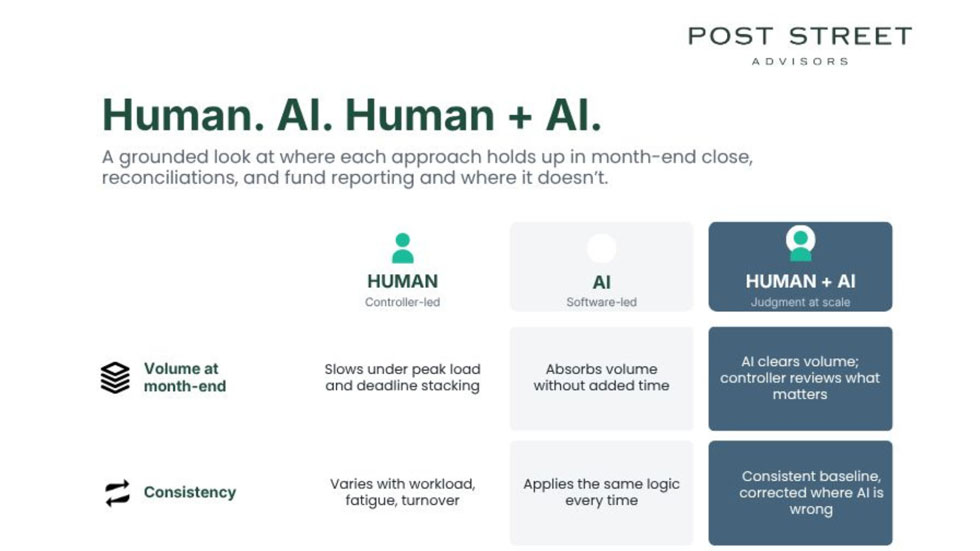
AI has obvious advantages in an operational environment. It can process large volumes quickly, apply the same logic repeatedly, and perform routine work at a marginal cost that is difficult to replicate through headcount alone.
But consistency is not the same as correctness.
When a situation falls outside the expected pattern, technology still needs a way to recognize that an exception exists and, more importantly, someone needs to decide what to do about it.
This is particularly relevant in private capital, where fund structures, LPAs, investment terms, allocations, and investor expectations can vary significantly from one fund to another.
AI may be able to tell you that something does not match the expected pattern.
An experienced person can ask why.
Human + AI is a stronger operating model
This is why we believe the more useful conversation is not Human vs. AI, but Human + AI. Each solves a different part of the operating problem.
AI provides capacity, consistency, and scale. People provide context, judgment, and accountability.
At month-end, for example, AI can handle much of the underlying processing and surface the transactions or calculations that require attention. Rather than reviewing everything with the same level of manual effort, a controller can concentrate on the exceptions and areas where professional judgment is required.
The technology handles the routine. The person owns the nuance. And before anything goes to an LP, a person still reviews and signs off.
Accountability cannot be automated away
That final point matters. Fund operations is not simply about producing numbers. It is about being able to stand behind them.
When an investor receives a statement, allocation, capital account, or other financial information, there needs to be confidence in both the process that produced it and the people responsible for it.
Technology can create a detailed system log. AI can flag inconsistencies. Automated workflows can make processes considerably more controlled and efficient.
But when something requires judgment, there still needs to be clear ownership.
For fund managers, that combination can provide something neither approach delivers particularly well on its own: technology-driven scale with human accountability.
The opportunity for emerging fund managers
This model has particular relevance for small and mid-sized funds.
Historically, achieving institutional-grade fund operations could require building an increasingly large internal team or accepting a cost structure that did not always make sense for the economics of an emerging fund.
Technology is beginning to change that.
The opportunity is not simply to replace people with AI and reduce costs. It is to design the operating model differently from the beginning, using technology for the work technology does well and experienced people for the work that requires experience.
As a fund grows, technology can absorb more of the additional volume while the operations team concentrates on the areas where its involvement matters most.
That creates the possibility of scaling the back office without scaling headcount at exactly the same rate.
Conclusion
AI will continue to become more capable, and the boundary between what is automated and what requires human involvement will continue to move.
But for fund operations, the goal should not be automation for automation's sake. The goal is a better operating model.
One where AI handles the bulk of routine processing. Where exceptions are surfaced rather than buried in volume. Where experienced fund administrators spend their time interpreting what matters. And where a person remains accountable for what ultimately reaches an investor.
AI creates the capacity. Human judgment creates confidence. The strongest fund operations model brings both together.